
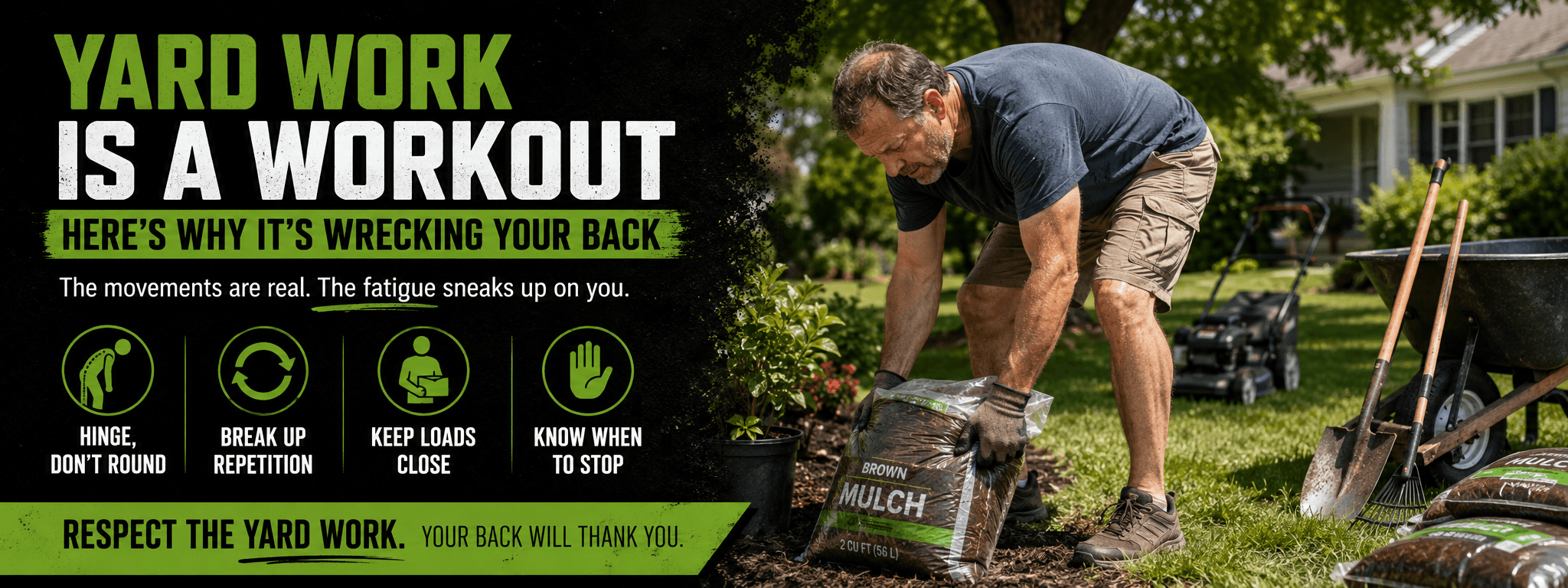
Yard Work Is a Workout — Here's Why It's Wrecking Your Back
Fitness
I hear this one constantly this time of year: someone throws their back out mowing the lawn or hauling mulch, and they're genuinely confused about how. I didn't even do anything hard.
Here's the thing — yard work isn't "not exercise." It's actually a pretty demanding one. It just doesn't look like a workout, so people go into it without any of the awareness they'd bring to the gym.
That mismatch is exactly why it wrecks so many backs every summer.
Why Yard Work Catches People Off Guard
In the gym, you know you're about to lift something heavy. You set up, you brace, you're paying attention to your form.
Yard work doesn't give you that same cue.
The movements are the same ones we coach around
Bending to pull weeds — that's a hinge pattern, same as a deadlift
Lifting a bag of mulch or a full trash can — same demand as a loaded carry
Repetitive raking or shoveling — rotational load, over and over, without rest
Kneeling and twisting to plant or dig — combined load your spine isn't used to
None of these are inherently dangerous movements. We program versions of all of them. The difference is intent — in the gym you're moving with control. In the yard, you're reaching for a weed or hauling a bag while thinking about literally anything else.
Volume sneaks up on you
A single deadlift gets your attention. Fifty small bends over two hours pulling weeds doesn't — until your back's already had enough.
The Pattern That Actually Causes the Injury
It's almost never the first thirty minutes that gets someone. It's usually somewhere past the hour mark.
Fatigue changes your form without you noticing. Your hips stop doing the work and your lower back starts compensating instead. You round through your spine instead of hinging at your hips. None of it feels dramatic in the moment — it just adds up, one repeated small compensation at a time, until something finally gives.
That's also why the same people tend to deal with this every single summer. The yard work itself isn't the root problem. It's that the same movement pattern breaks down the same way every time, and nothing's been done to fix the pattern in between.
How to Actually Protect Your Back Out There
You don't need to treat mowing the lawn like a training session. A few adjustments go a long way.
Set up like you would with a real lift
When bending to lift something — a bag, a pot, a full trash can — hinge at your hips and let your legs do the work, not your lower back
Keep whatever you're carrying close to your body instead of reaching it out in front of you
Brace before you lift, the same way you would with any weight in the gym
Break up the repetition
Long stretches of the same motion — raking, weeding, shoveling — are where fatigue quietly takes over. Standing up, resetting your posture, and taking a short break every 20-30 minutes does more for your back than almost anything else on this list.
Know your actual limits that day
If your back's already been cranky, or you didn't sleep well, or you're already sore from training earlier in the week — that's not the day to knock out four hours of yard work in one shot. Split it up. It'll still get done.
If Something Does Start Bothering You
Mild soreness the next day is normal — you used muscles you don't always use, plain and simple.
Sharp pain, pain that radiates down a leg, or anything that doesn't ease up after a day or two of normal activity is a different story, and that's worth getting checked by a doctor or physical therapist rather than pushing through it.
At HBR, we actually see this pattern a lot when someone comes in after a summer of yard work — we'll look at how they're hinging, carrying, and rotating, and build that into the program so the same thing isn't happening again next season.
The Real Takeaway
Yard work isn't something to be afraid of. It's just something worth respecting the same way you'd respect a heavy set at the gym.
Hinge instead of round. Break up the repetition. Know when your body's had enough for the day. Small adjustments, same yard work, a lot less chance of spending the next week with a bad back.
If your back's been a recurring issue — yard work or otherwise — we can help you figure out what's actually driving it and build a plan around it.
ARTICLES


