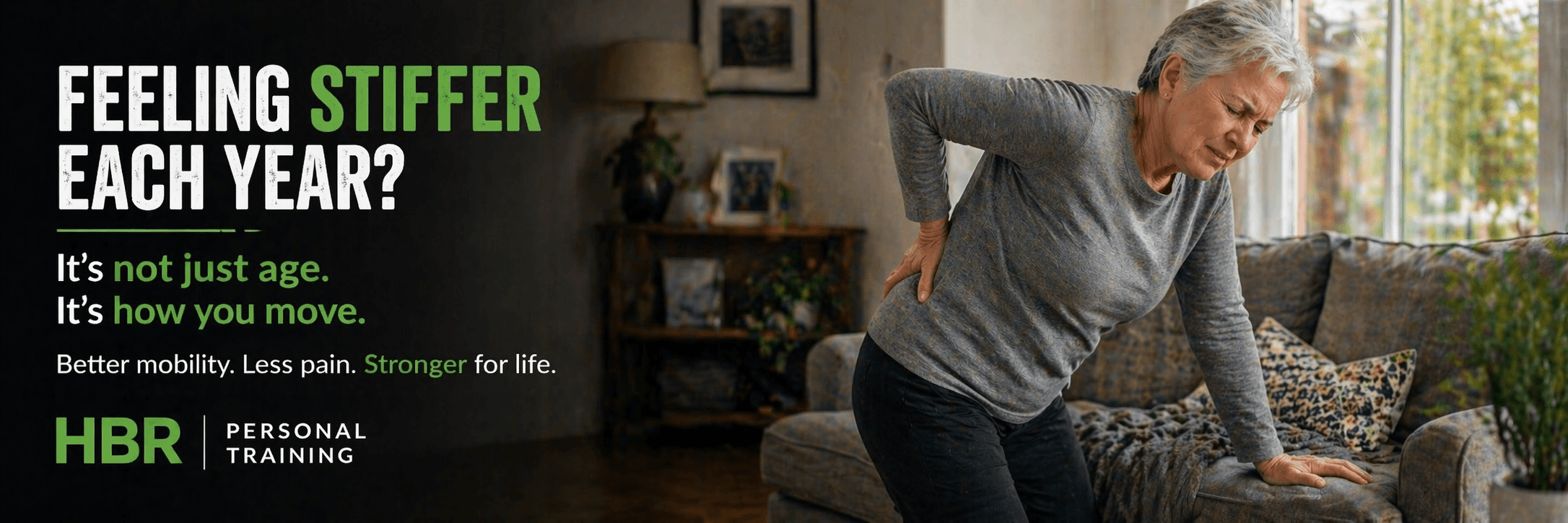
Why You’re Getting Stiffer (And It’s Not Just Age)
Fitness
By Coach Brad
I hear this a lot:
“I’m just getting older.”
“That’s just how it is now.”
“My hips have always been tight.”
Maybe.
But most of the time, what people call “getting older” is really just losing mobility and not training it properly.
And that’s fixable.
Tight Isn’t Always Tight
When someone says they’re tight, it’s usually not because the muscle suddenly shortened.
More often, it’s because the joint doesn’t move well — or the body doesn’t feel strong in that position.
Your body limits what it doesn’t trust.
If you don’t have strength and control in a certain range, your system will tighten things up to protect you.
That stiffness you feel? A lot of the time it’s protective.
Stretching alone doesn’t solve that.
Control does.
Mobility Is About Control
Flexibility is passive. Mobility is active.
You might be able to get into a deep squat if someone pushes you there.
But can you control that position under load?
Can you stay stable there?
That’s the difference.
When mobility is lacking:
Ankles shift stress into knees
Hips dump pressure into the lower back
Shoulders compensate during presses and pulls
You can still train like that — for a while.
Eventually, something starts barking.
Why It Shows Up More After 40 or 50
As you age, small movement issues don’t disappear on their own.
Recovery changes. Tissue tolerance changes. Stress outside the gym adds up.
If mobility isn’t part of your training, you start noticing:
Squats feel restricted
Shoulders don’t move overhead comfortably
Hamstrings tighten up again and again
The same spots flare up every few months
It’s not that you can’t train hard.
It’s that the foundation isn’t being maintained.
What Real Mobility Work Looks Like
It’s not 20 minutes of random stretching at the end of a workout.
It’s:
Strengthening through full range
Cleaning up movement patterns
Addressing asymmetries
Building control where you currently feel restricted
Sometimes that means adjusting depth.
Sometimes it means slowing the tempo.
Sometimes it means backing off load to build control.
It’s not exciting.
But it keeps you lifting five, ten, fifteen years from now.
The Goal Isn’t To Be Loose
The goal isn’t to be “flexible.”
The goal is to be capable.
To squat without your back taking over.
To press without shoulder irritation.
To hinge without your hamstrings constantly pulling.
Mobility supports strength. It doesn’t replace it.
If you want long-term health, it has to be part of the plan.
If you’ve been feeling stiffer every year and just assuming that’s aging, it might be worth taking a closer look at how you’re training.
👉 Book a free workout and we’ll look at how you move and where small changes could make a big difference.
You don’t lose mobility because you age.
You lose it because you stop training it properly.
— Coach Brad
ARTICLES


