
Why Body Composition Matters More Than the Scale
Fitness
By Coach Brad
Most people still judge progress by one number: body weight.
If the scale goes down, they assume things are working.
If it doesn’t, they assume something is wrong.
The problem is, weight alone doesn’t tell you what’s actually changing.
Two people can weigh the same and have very different health profiles. And one person can stay the same weight while their health improves significantly.
That’s where body composition becomes important.
Weight Doesn’t Show the Full Picture
The scale measures total mass.
It doesn’t separate:
Muscle
Body fat
Bone density
Water retention
If someone gains muscle while reducing body fat, the scale may barely move.
If someone loses weight quickly but most of it is muscle, the scale will drop — but long-term health may not improve.
When you focus only on weight, you risk chasing the wrong target.
Muscle Mass Is Protective
As we age, maintaining muscle becomes more important.
Muscle supports:
Metabolic health
Blood sugar control
Joint stability
Balance and fall prevention
Functional independence
Losing muscle over time increases the risk of injury, metabolic issues, and reduced mobility.
That’s why long-term health isn’t just about lowering body fat. It’s about maintaining or improving lean mass while managing body fat appropriately.
The scale doesn’t show you that balance.
Body Fat Distribution Matters
Total body fat percentage matters, but distribution also plays a role.
Higher levels of central body fat (around the abdomen) are associated with increased risk of:
Cardiovascular disease
Insulin resistance
Type 2 diabetes
Hypertension
Tracking body composition allows us to monitor trends — not just whether weight is moving, but what direction overall health markers may be heading.
It shifts the focus from appearance to risk management.
Why We Use Objective Data
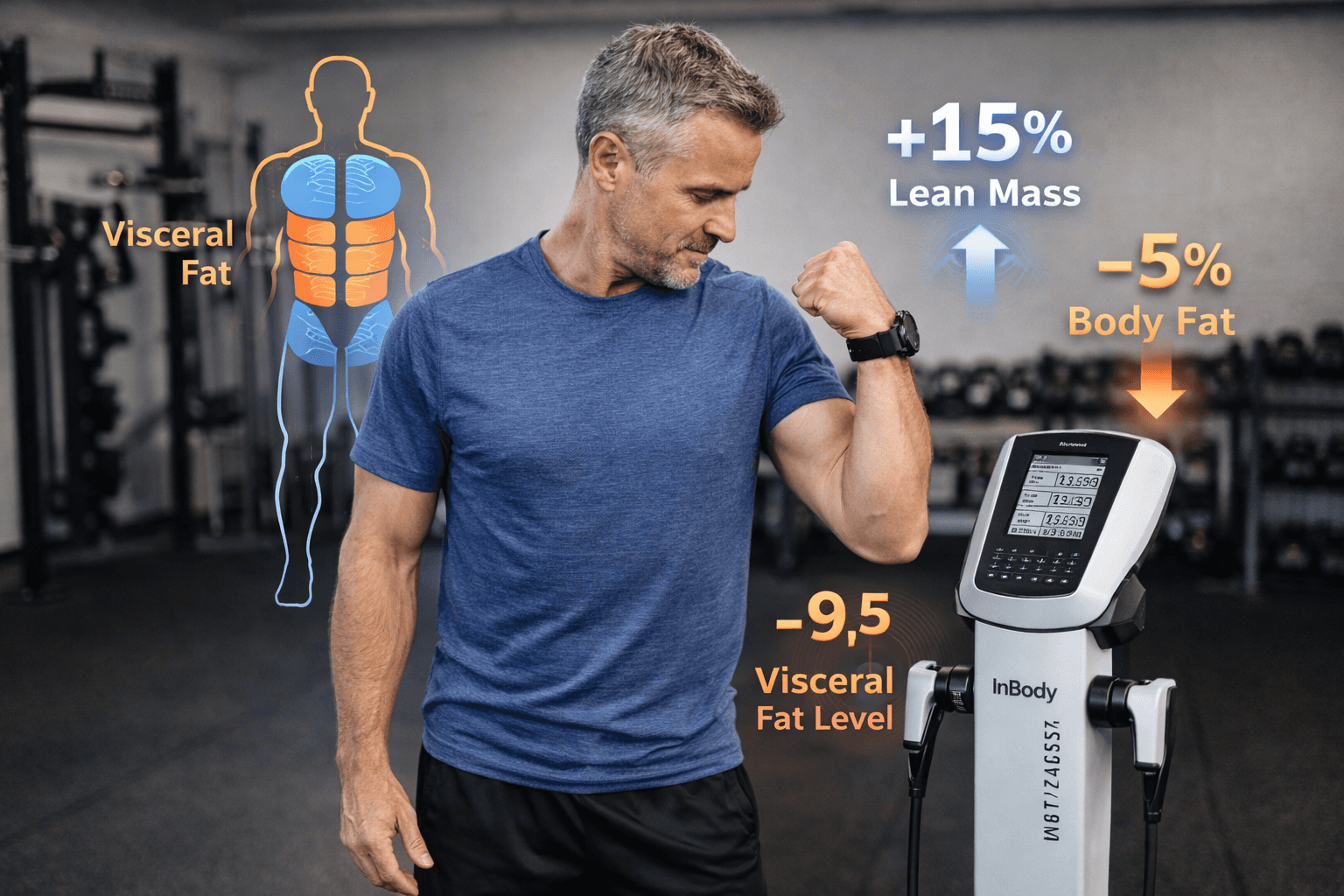
That’s one reason we use tools like the InBody Scanner.
It allows us to measure:
Lean body mass
Body fat percentage
Segmental muscle balance
Visceral fat levels
It’s not about obsessing over numbers.
It’s about having clarity.
When someone sees that muscle mass is increasing while body fat is decreasing — even if the scale hasn’t changed — frustration usually drops.
They understand what’s actually happening.
And when someone sees muscle decreasing, that’s useful information too. It allows us to adjust training and nutrition before it becomes a bigger issue.
Long-Term Health Is About Trends
Quick changes don’t matter as much as direction.
Are you gradually improving muscle mass?
Is body fat trending downward or staying within a healthy range?
Is strength improving alongside composition?
Those patterns tell us far more than daily scale fluctuations.
Over months and years, that data paints a clearer picture of health than weight alone ever could.
Shifting the Goal
For long-term health, the goal isn’t just “lose weight.”
It’s:
Improve body composition
Preserve muscle
Manage body fat
Support metabolic health
Maintain function
That’s a more complete target.
And it’s one that supports strength, mobility, and independence as you age.
If you’ve been relying only on the scale to judge progress, you may not be seeing the full story.
👉 Book a free workout and we can review your current training and, if appropriate, assess your body composition to see where things actually stand.
Weight is one data point.
Body composition gives context.
ARTICLES


