Posture & Lifting: Should You Be Squatting or Deadlifting More?
Fitness
This question comes up more than you’d think.
“Which one is better for posture — squats or deadlifts?”
Most people are expecting a clear answer.
But it’s not that simple.
Because posture issues don’t come from one missing exercise. They come from how you move, how you sit, and what you repeat every day.
So the better question is:
Which one do you need more right now?
Posture Problems Usually Start With Imbalance
When someone comes in and says their posture feels off, we’re not looking for a single fix.
We’re looking at patterns.
Tight hips from sitting too much.
Weak upper back from not enough pulling.
Core not doing its job during basic movements.
That’s usually the starting point.
So instead of asking, “Should I squat or deadlift?” we’re asking:
Where is the breakdown happening?
Squats: When You Need More Control and Positioning
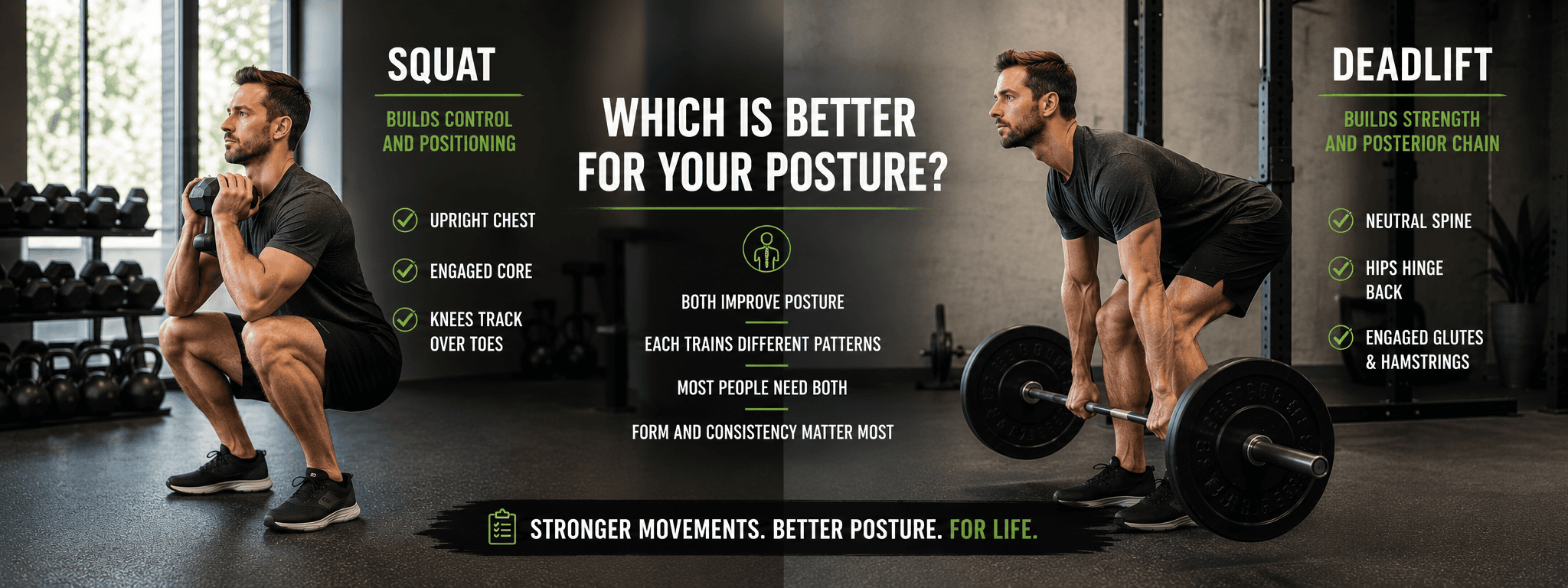
Squats are great for teaching control.
They force you to stay upright, keep your core engaged, and move through your hips and knees together.
If someone struggles with:
Staying upright when they move
Knees collapsing inward
Lack of control at the bottom of a movement
We’ll usually lean more into squat patterns.
Not necessarily heavy right away — just consistent, controlled reps that clean things up.
For a lot of people, especially those newer to training, this is where posture starts improving first.
Deadlifts: When You Need to Rebuild Your Posterior Chain
Deadlifts hit a different side of posture.
They train your ability to hinge — which is something most people have lost.
Instead of bending through the hips, people round their back. That’s where a lot of discomfort and long-term issues start.
So if someone struggles with:
Rounding through the lower back
Not knowing how to hinge properly
Weak glutes and hamstrings
Deadlifts become a priority.
Again, not max effort. Just learning how to move properly under load.
That alone can clean up a lot of posture-related issues.
Most People Actually Need Both
This is where the “either/or” mindset falls apart.
Squats and deadlifts don’t compete with each other. They complement each other.
One builds control and positioning.
The other builds strength through the backside.
If you only do one, you’re usually leaving a gap somewhere.
At HBR, we don’t remove one unless there’s a reason. We adjust how they’re used based on what the person in front of us needs.
That might mean:
More squat variations for a while
Lighter deadlifts focused on form
Or breaking both down into simpler movements first
It’s always based on what we’re seeing — not a fixed template.
Form Matters More Than the Exercise Itself
This is the part that gets overlooked.
You can squat and still have poor posture if the movement isn’t clean.
Same with deadlifts.
If the goal is improving posture, the quality of the movement matters more than the load, the reps, or even the exercise choice.
That’s why a lot of people don’t see progress even though they’re “doing the right exercises.”
They’re just reinforcing the same patterns.
What This Looks Like in Practice
For most people, improving posture through training looks like:
Slowing things down
Cleaning up basic movement patterns
Building strength gradually without forcing it
Inside HBR sessions, that usually means we’re watching closely, making small adjustments, and building from there.
It’s not about picking the “better” exercise.
It’s about using the right one at the right time.
If you’re not sure which movements you should be focusing on — or you feel like something’s off with your posture — we can help you figure that out and build a plan around it.
ARTICLES


