
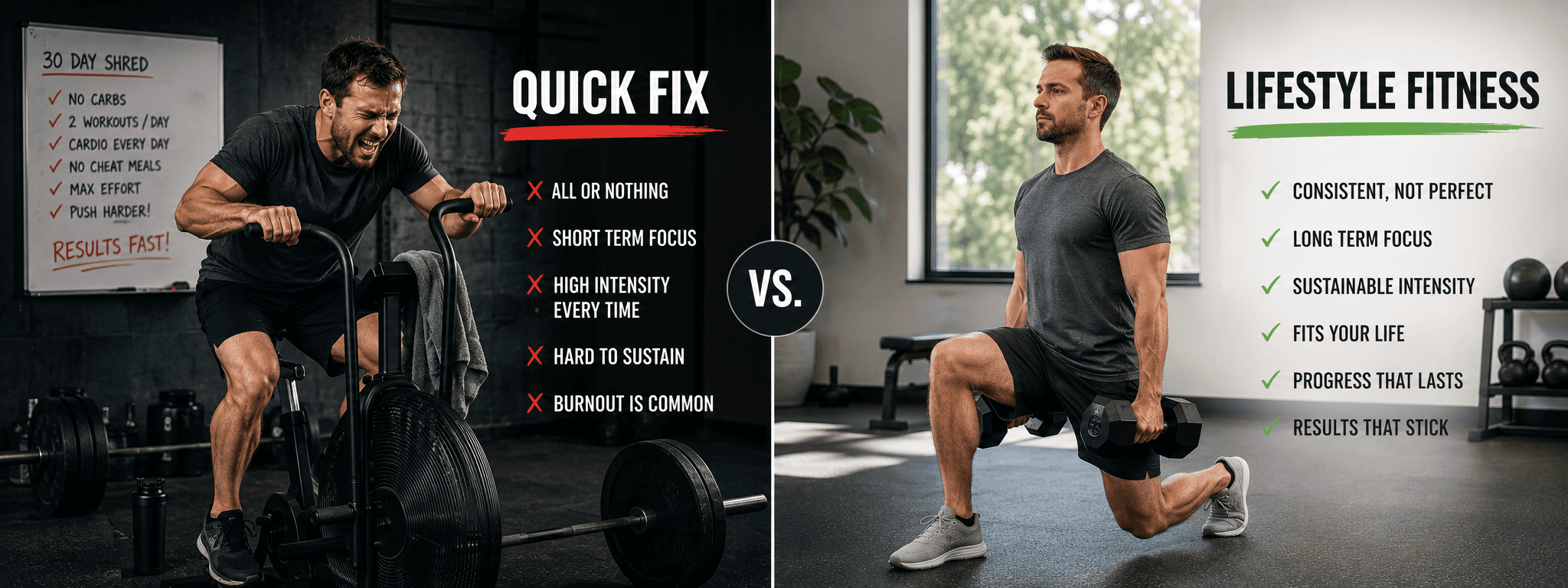
Lifestyle Fitness vs. Quick Fixes: Why One Actually Lasts
Fitness
Most people don’t struggle because they don’t know what to do.
They struggle because what they’re doing isn’t built to last.
Short-term programs, strict diets, all-or-nothing plans… they work for a while. You can get results. You can even feel great during it.
But then life steps in.
Work gets busy. Schedules shift. Energy drops. And suddenly, the plan doesn’t fit anymore.
That’s usually where things fall apart.
Quick Fixes Are Built for Short-Term Wins
There’s a reason quick fixes are appealing.
They’re clear. They’re structured. They give you something to follow without thinking too much.
And for a few weeks, that can be helpful.
But most of them rely on conditions that aren’t realistic long-term — perfect schedules, high motivation, strict rules.
Once those conditions change, the system breaks.
Not because you failed.
Because it was never designed to adapt.
Lifestyle Fitness Adjusts With You
This is the shift most people need to make.
Instead of asking, “What’s the fastest way to get results?”
You start asking, “What can I actually keep doing when life isn’t perfect?”
That usually looks less intense — but more consistent.
Training a few times a week instead of every day.
Building meals around real life instead of strict plans.
Adjusting when things get busy instead of stopping completely.
At HBR, that’s how we approach it.
We’re not trying to win a 6-week window. We’re trying to build something that still works six months from now, a year from now.
Consistency Beats Intensity Over Time
This is where people get frustrated.
They feel like if they’re not pushing hard, it’s not working.
But what actually moves the needle is showing up regularly.
A few solid workouts every week.
Progressing at a pace you can recover from.
Not having to “restart” every time life gets busy.
That’s how strength builds. That’s how habits stick.
And that’s what most quick fixes miss.
You Don’t Need to Be Perfect — You Need to Stay in It
This is one of the biggest mindset shifts.
People fall off because they think they’ve “messed it up.”
Missed workouts. Ate off-plan. Got out of routine.
So they stop.
But the people who actually make long-term progress don’t do that. They adjust and keep going.
Shorter session. Lighter day. Simpler week.
Still moving.
That’s something we reinforce a lot during sessions at HBR — not just what to do when things are going well, but how to keep going when they’re not.
What This Looks Like in Practice
Lifestyle fitness isn’t random.
There’s still structure — it just fits your life instead of fighting it.
For most people, that means:
2–4 workouts per week that are realistic to maintain
A focus on strength and movement that progresses over time
Flexibility to adjust based on schedule, stress, and energy
Inside HBR, that’s where coaching makes a difference.
We build a plan that works on a normal week — and then we adjust it when life isn’t normal. That’s usually the missing piece for people who’ve tried multiple programs before.
The Goal Isn’t Fast Results — It’s Lasting Results
Fast results can be motivating.
But if they disappear just as fast, you’re back where you started.
Or worse, repeating the same cycle again.
The goal is to build something steady.
Strength that stays. Habits that don’t fall apart. A routine that doesn’t rely on perfect conditions.
That’s what lifestyle fitness actually gives you.
If you’re tired of starting over and want a plan that actually fits your life, we can help you build something that lasts.
ARTICLES


